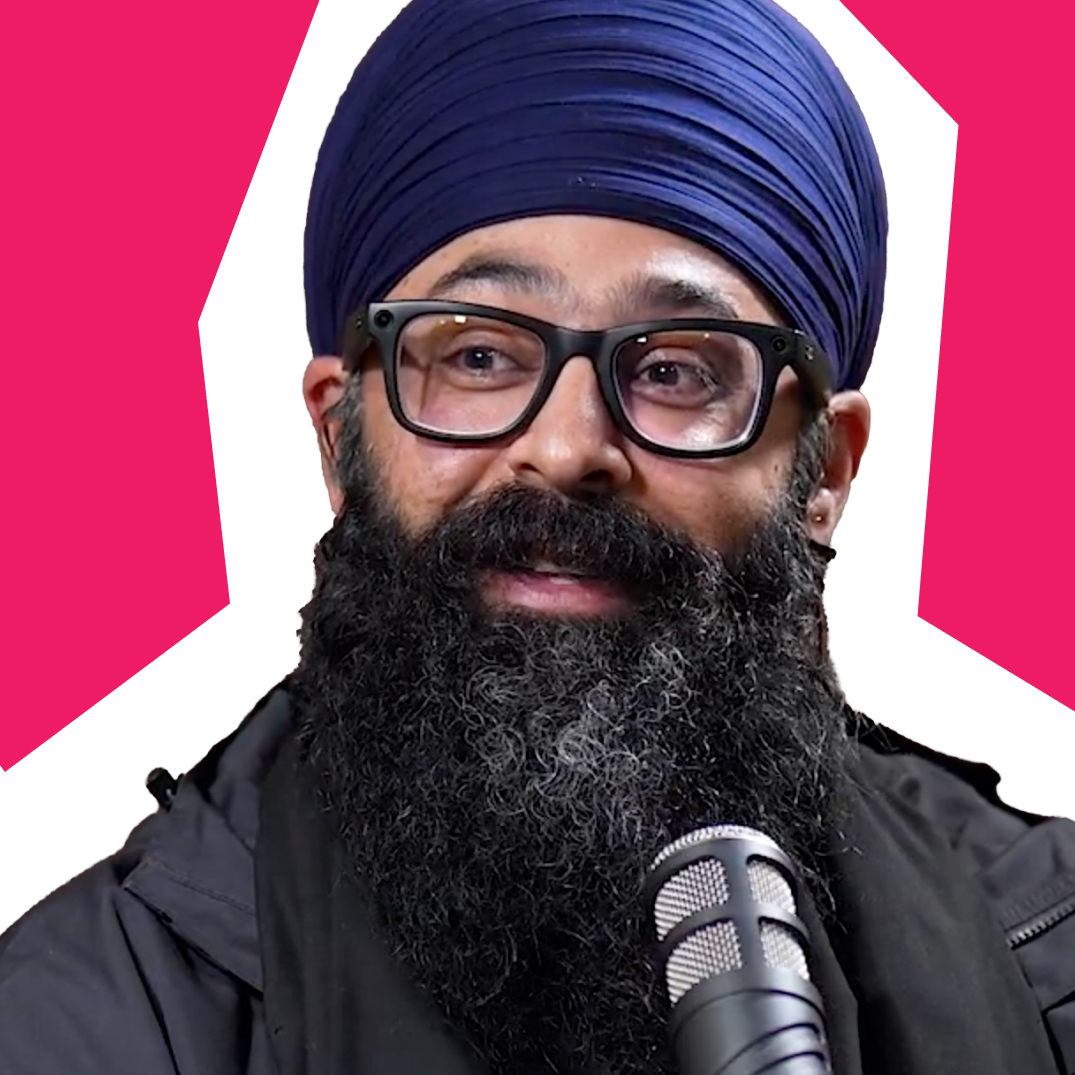


Guest appearance

Moninder Singh is a seasoned health and safety leader with extensive experience spanning higher education, healthcare, and construction sectors.
Footnotes
Episode transcript
Moninder Singh 00:31
I never wanted to hit a point in life where I didn't take a risk or do something because I was afraid. The unknown is one of the biggest fears out there. Cause you just don't know, and sometimes you just sit at home and people will just wallow in this unknown of what's going to happen tomorrow, what's going to happen here, what's going to happen here. And they spend more time worrying about the actual issue than actually dealing with it. One of the things I've actually gained more than anything in this activist-type life is to let go of that control. Is that, I have a job and a role and a mission, and everything else is out of my control, so whether I live or die is out of my control. So I'm not going to worry about that. And then, if I go to the next step, "Are people going to like me or not like me?" It's like, it's not the 6th grade anymore, I don't care anymore.
Mo Dhaliwal 00:31
Welcome to High Agency, igniting conversations with inspiring people leading transformative change. In the summer of 2022, our CMP officers showed up at the door of a suburban home in a quiet neighbourhood of Surrey. They had an unusual message, a foreign government once you dead. It was a duty to war notice, a formal notification of an imminent assassination threat, and the recipient was told to leave his family immediately or his children would actually be removed from the home for their own protection. At the time, Canada found itself in an unprecedented diplomatic crisis. In 2023, Prime Minister Trudeau stated in Parliament that there was credible allegations that the Indian government had agents orchestrating murders on Canadian soil. Six diplomats were expelled. International scrutiny of transnational repression targeting Sikh activists in the diaspora was increased. And at the center of it all, a small community of advocates who've spent years warning anyone who would listen, watched while their friends were getting killed. And in 2025, the government of Canada has executed a 180-degree turn, rapidly moving to normalize relations and strengthen ties with the government of India, leaving Canada's Sikh diaspora feeling like the economy has superseded their rights and freedoms.And today's guest has received not one but three of those duty to war notices, and he refuses to stop speaking out. He's spoken out in Canada, around the world, and regularly travels to Geneva, Switzerland to represent Sikh interests at the United Nations. He's done this while holding numerous leadership positions at major institutions in this country, ironically, as a senior executive in health and safety and operational roles. Moninder Singh is a Canadian-born Sikh activist. He's the former COO of the BC Nurses Union, and a co-founder of Sikh Federation Canada. His close friend, Hardeep Singh Nijjar, was assassinated by suspected Indian agents on Father's Day in 2023. Monender received his first death threat warning on the very same day that Nijjar received his. Moninder Singh, thanks for joining us.
Moninder Singh 03:05
Mo, thanks for having me.
Mo Dhaliwal 03:08
So, you're the first of our guests that we've ever had on this couch, or I'd say in the studio, that is under threat of assassination. And it's an interesting conversation for a number of reasons. One is that obviously it's a very real thing, because you had CSIS, you had, you know, Canadian security apparatus actually come straight out and warn you that this is happening. And yet, you have to live your life. You have to go to work and do what you do and try to proceed. But you have this massive sort of threat weighing on you and hanging over your head. But life wasn't always like this for you. And, you know, I want to kind of start from the beginning of your story and learn about how you landed yourself in the bullseye of a foreign government and how this all started in Clearwater, which, I mean, I could be wrong, but for, you know, a population of 2000 in British Columbia, I don't understand it to be a nexus of political intrigue. Maybe it is, I don't know. But you grew up in Clearwater, Clearwater, BC, tiny town.And where did this political consciousness wake up? And how did that relate to your early life in this tiny little town in British Columbia?
Moninder Singh 04:32
Oddly enough, Clearwater has a connection to our family that actually is quite old. We didn't know that until about maybe a decade ago. My father came to Canada in around 1970. He settled in Vavenby, Clearwater, it was like a mill town, saw a mill town, like a lot of softwood lumber towns that were in BC at the time. And my mom came over, they made a little life for themselves, bought a little house, small little knit community there. But what we found out actually afterwards was my dad's great grandfather had actually been in Clearwater and Vavenby in the early 1900s, working in lumber and in forestry. He went back after the First World War, never came back. My dad actually, out of all the places in the entire world, all the places in Canada, British Columbia, whatever you want to call it, ended up in the same town as his great grandfather, almost like 60, 70 years later, and almost like 100 years later, we as kids were like, oh, well, we have a really long history in this space, like over 100 years.And so just the kind of the connection piece. And it's interesting because when people say to me, like, what's home? I speak of Punjab, I guess, and where my parents came from. And there's this deep connection most Punjabis have with Punjab. But my mind always goes to Clearwater as home as well.And it wasn't a place where you would say, yeah, this, you know, there's like this political movement running or this. It was a place that shaped me, though. So and I think the shaping had to do a lot with multiple facets. One was the immense amount of community and goodwill of certain people in that space. And the other was the complete racist discrimination of others in that same space. And the bullying, the, you know, the verbal, physical abuse growing up, you know, looking the way we do, we were the only ones that were, my father was a baptized Sikh on Amrit Ki Hai. We were born and raised and with like unshorn hair. So we had small turbans as we went to school. And we ran into a lot of things, like when I was 13 years old, I ran into this situation where I were an actual like best-daughter turban to school for the first time of sitting in the cafeteria. This guy in grade 12 ripped it off my head, ran into the washroom and threw it in the toilet. And, you know, then I had to go and get it out of the toilet, wash it. You know, people are laughing, this, that and the other. I walked home because we all walked to school, such a small town. And I told my mom what happened. My mom grabbed another turban, tied it on my head and said, go back to school. And she gave me a little lecture around like who you are, not being discouraged, being confident, giving self-esteem. It was tough because, you know, the daily things that you were experiencing were, you know, you're lesser, lesser, lesser. And then, you know, the kind of like the going home and having your parents tell you that, no, you have to kind of like keep doing this, you have to keep doing this. And you get into the struggle with yourself as I'm like, why do I have to do this? So your identity for my identity, for me, actually initially became the problem that I didn't like it. I didn't like the fact that I was different. I looked different. And because of that so-called difference, people were attacking me. And that's, you know, like as of any 7, 8, 9, 10, 12, whatever year old, it's common, it's natural.One thing I started doing a lot was because of that kind of open bullying that was happening, I started reading a lot. And the reading for me was history. It was politics. It was Malcolm X. It was Che Guevara. It was my own historical, you know, writings from like Punjab and the Sikh faith. And I wasn't overly into Sikhi or into like faith-based studies or anything like that, but I loved the revolutionary part of it. I love the idea of fighting back. I like the idea of these people that were being kind of like messed with and then they found a way to get back at people or they found a way to, you know, like as in like be confident in their own kind of like skin at the end of the day. And then that drew me in into that kind of space. But then that kind of also shows like as in like what foundation was being laid at that young age for whatever I was planning on doing in the future. And I'm not sure if I had complete control over it or the natural progression was such as that my experiences helped shape me and I wouldn't trade those experiences.And now for the world, like as in that kind of got me to this point and you know, like as in they go back and I look at those times and if you can make it through some things in life, you can make it through anything. And then kind of like in the face of these kinds of threats that the government of India is making today, if we get into the present day, it's like to me, that foundation that was laid in Clearwater, it was knowledge, it was, you know, it was a lot of community and love. It was persevering. It was confidence in the face of what at that time would have just been something in most people's minds, something really small, everyone gets bullied, everyone.And they do. It's unfortunate, but people do. But for me, it's like I held on to that. I held on to this idea of justice. I held on to this idea of not taking it and finding ways to like, as I'm like, you know, exert my own kind of power at the end of the day. So I think all those things is what for me, Clearwater is and that's why I think I have such a deep connection with Clearwater. I go back, I walk the same roads that I used to run down trying to get away from bullies or the the forest, there's a high school and there's a forest behind it. And I used to sit in that forest because there's like trees and I love trees. And I thought I think I started loving them because to get away from people, I'd climb them. And it's kind of funny and it's sad and it's it's real. And I think those are the reasons why I have like a deep affinity for it because it it shaped me into what I feel are probably some of the best attributes I have and it helped provide those. So I think that's my connection to it.
Mo Dhaliwal 10:28
That's really interesting because I can tell you growing up on the predominantly white part of Abbotsford, BC up until the third grade, and I'm not visibly Sikh, so I don't carry the Articles of Faith. But that was hard enough, and I carry some scars from that time, and I remember those periods.But it's also the age because threat at this point and stage in your life can sometimes feel like an abstract thing, even though the threats are way more real and larger and more consequential. Whereas at that age, you could say that the threat is maybe smaller and less consequential, but oh my god, it rules your entire perspective and has the most outsized impact on you because it's everything, right? I remember the bell would go off, whether it was recess or lunch, and just you start running. Because for a while I just thought it was normal to depend on it at lunch. It's your whole world, so it's a massive, massive impact. But you mentioned that there was the other flip side of the coin, a sense of community in Clearwater as well, and we experienced that as well in a small town because as much as school might have been brutal up until the third grade, there was families in our cul-de-sac and neighbours that we kept in touch with for years because just beautiful people really open and welcoming. But what was the community like and where do you find community in Clearwater?
Moninder Singh 11:52
The vast majority of people, like, were just like, so caring like, as in like it's just a small town so everyone was always helpful everybody knows each other yeah everyone knows each other their kids their parents their grandparents like it's, it's one of those places where everyone knows everyone. And everyone works in like three different places so if you're doing something your parents are probably going to find out because someone's going to rat you out. So it's it was one of those places.
Mo Dhaliwal 12:15
So that was your first experience of surveillance as well
Moninder Singh 12:18
Yeah, yeah you never who was the eye but it was-- a I had a friend um Skye Buck and um whenever he was a year younger than i was but whenever I was being pecked on or people would try to like you know bully me or or beat me up um this kid would come out of nowhere if he was around and he would just start fighting on my side and he was like always there always and he sometimes most of the time he got beat up with me. But and all for years I had no idea why he would do that I guess i'm like and it wasn't like because we were friends at that age we became friends as we got a little bit older but when i was in like grade two grade three grade five and we weren't friends so about high school but he would just come he would fight he'd get his ass kicked with me and then he would just walk away and then go back to his own little crowd. And I had no idea, and in high school like we became friends like you know basketball, volleyball, track and field... like I was into sports and we got closer and closer I never really really asked him ever why he would do that but there's just kind of like this thing like with this kid.
Mo Dhaliwal 13:20
Solidarity. A sense of justice?
Moninder Singh 13:22
You know his parents were teachers in school there and he would just brought up very well just a brilliant kid at the end of the day. You know, he passed away, him and his wife, Courtney they..their car went into a river in the winter it used to live in Kamloops but an hour away, and i remember when um when he passed away it was like a shot in the heart like as in like because you you lose touch with people and you forget like as in like people that got you through moments and then all of it comes back as to like how important somebody was in that moment there was probably nobody more important for a number of years than him just the small comments we would make to one another or that solidarity together and then it hits you like just like a ton of bricks, because you lose touch like over time like whether it's colleagues or friends or family and then you kind of curse yourself as to like you know what am I doing in life? And is it more important than this? And I think everyone does it it's a reality in everyone's life you have so much time and how much time can you give to whoever but like to me it was one of those people that you know you're saying like where did the solidarity come from, like as in where where did that love come from a lot of the love was shown like even if people weren't with you like every day of every moment of every day.
Mo Dhaliwal 13:22
Had some time to demonstrate it.
Moninder Singh 13:22
Yeah but the demonstration of it was you know people standing up for you and more people actually being on your side with them also being afraid and that really was one of those spaces that really showed me that that you can be the majority but a very local like very vocal loud minority can somehow just take over an entire space. Whether that's a little high school in Clearwater, or whether that's society in general and when the majority goes silent there is no bigger danger to society, when you know you yourself everyone goes silent in the face of a very loud vocal minority that is preaching hate or differences or inequality or any of these things. So I think for me like this stuff was shaping me without me even knowing it but these things were being considered by me. And like I was saying the reading I was doing at the time uh was was really important afterwards like you know the idea of social justice the idea of standing out the idea of being able to change things the idea of even being one voice um you know that's countering something that's wrong that you still have to be that voice in the face of you know whatever could potentially happen um i think all those things were happening and i think it made it easier for me as i moved into this transition of life that I'm going to stick to those principles and ethics and morals.
Mo Dhaliwal 16:00
That's an incredible story. I mean, Skye Buck, that even sounds almost like a superhero.I mean, you couldn't come up with a better character for some sort of comic book or something of just this force of nature that appears out of nowhere, gets his ass kicked and retreats quietly.
Moninder Singh 16:18
Yeah, his sister's name was Winter. So they have the family names and stuff like that. But their parents were teachers in school. They were actually our karate and taekwondo teachers as well after school. So we had these things. So all the people that you saw at school, your teachers were sometimes your extracurricular activity coaches. His mom was our volleyball coach. His dad was a volleyball coach for the boys that were older than us. So the community was always connected somehow.As in, there's always this thing. You saw them after school. You saw them at the grocery store because there's only one grocery store. You saw them at the gas station because there's only two gas stations. So you saw each other everywhere. There's only so many streets and so many places for so many people. And the beauty of the place was that actually, is that you were constantly in touch. It was one of those towns that you see in the movies that every Friday night was skating at the ice rink. And the whole town would pretty much show up and the people would have like hot chocolate out and there'd be a concession stand, popcorn. And the kids would, like 100 kids would be on the rink playing around, running around, pushing each other. The parents would be sitting in the stands talking to one another. So you had these gatherings of community.And that's what, I think I had this nostalgia with it. That, you know, those better times, even though there was these adversarial-type times, but it was simpler. Like as in like the difference was like, I always talk to my kids now. And like the difference then was somebody didn't like you. They had to come to your face and say that I'm like, there was no such thing as talking shit on social media or, you know, texting or WhatsApp or making groups about people. And now even getting into this phase of AI, of using AI to generate images of people. And you never had any of this. So if you don't like somebody, you threw down fac-to-e to face and then you brushed each other off and you went about your day. There was no such thing of just sitting around and waiting for someone to hate on you on a device, which has become like the central point of everyone's life.So I think there's a bunch of things in my mind when I think about like Clearwater is like, it was free. And then when I say losing, I always say, oh, don't I go, we lost like a lot of freedom. And the freedom was just of your mind. Like I wasn't being able to actually be free of these hateful, hurtful, like kind of comments that people make and what they do. And it's like, unless somebody saw you, unless somebody got right up in your face, you usually didn't know. And it was like, sometimes it was just better that way.
Mo Dhaliwal 18:39
Yeah. I mean, and there's a certain, I mean, as bad as bullying is, there's a certain humanity to that type of bullying. And that makes cyber bullying quite disgusting for what it is, right? I mean, there's been so many cases now of the type of psychological trauma that it creates, where in some cases, actually a little bit of physical aggression might actually be better than this constant and consistent sort of psychological torture that young people face these days.And the scene that you painted of like, you know, the ice rink during winter and, you know, an evening, I mean, paints like some pretty quaint pictures of the idyllic sort of Canadiana, right? But obviously, you're not in Clearwater anymore. So something got you out of there. So what took the family out of Clearwater?
Moninder Singh 19:24
Well, there's nowhere to go to school in the brawn. So the rest of our family is actually in the Surrey area. My dad has six other siblings. And my mom has four other siblings. Everyone was in Surrey. My whole family in the 80s moved here. My parents were the first ones that came. Then both sides of my mom's side, my dad's side, everyone. And everyone's actually in Surrey. There's no one outside of Surrey. No one's in Abbotsford. No one's in New West Minister. Everyone's in Surrey. So naturally, for me to go to school, the idea was, go where family is, it's safer.You have people. And Surrey has a large Punjabi, Sikh community as well. So it was like, OK, this is safe. This is easy for a kid that's coming out of 2,000 town space, that it's a place that I'd feel comfortable in. And when I made the jump here into, Surrey, I started going to university, college, that educational side, but what I really got into was, there's a bunch of people I ran into here that were into Sikh politics. And it was something that just drew me right in. Almost like the day I got here, within a week, I was involved in, as in, like, Gurdwara programs, or youth speaking. I didn't know I liked to speak. And then I figured out, OK, I'm not bad at it. And then I started speaking. And by 18, I was speaking at seminars, spaces like that. So I think I got into it right away. So it was actually school that drew me here. And immediately, I got involved in the political landscape. And then it was more about solidarity. It was meeting other people, like Kashmiris and others, who were actually fighting self-determination movements, sovereignty movements for their freedom, meeting Palestinians, and meeting Indigenous people, and understanding things a little bit better. And this is what we're talking about, the late 1990s, early 2000s, and really getting into the space, and then understanding the space, and understanding you're not alone. And that was a big one for me, is that you're not alone.
Mo Dhaliwal 21:24
So was it the move that actually woke up the political consciousness? Cause I mean, you said you were reading a lot before that.Yeah. And you know, revolutionary, um, you know, both actors and writers. But obviously there isn't necessarily the same sort of tension in a place like Clearwater. So it was the move that kind of woke that up?
Moninder Singh 21:40
I've always seen it as in like people have an interest in stuff, and if you're not active in anything your interest doesn't do much. Aside from maybe makes you sympathetic or maybe a little bit more empathetic. But at some point there has to be action behind like what you're learning, so I had nowhere to actually exert any action in Clearwater. So I think there was an awakening for me personally like in my teens, and I think it was because of my personal experiences and then what I was reading was influencing that as well, so I hadn't even till now I haven't perfected anything when it comes to like as in like I keep learning every day to be a Sikh at the end of the day is to learn so it's like when I was learning there I know where to actually take this and go and meet people and talk about things because the community was so small in general there's no application yeah and when you came out here in like this hub of like Greater Vancouver it was like it was everywhere like as in there's so many different movements so many different things going on so many different types of people and that gave me a I think a platform to speak at other people's events, to sit on panels, to watch to learn a lot as how people were navigating this space, so it kind of gave me that but I do believe like as I'm like there what I was reading, and a lot of it was like not Sikh oriented, it was other movements other political systems, and then when I started focusing more on the Sikh political spectrum and learning more, I think I started kind of looking at like how does this interconnect. And then like the Sikh political space for me really opened up, like as in like the idea the idea is you know how to look at the world and and kind of just like bettering yourself as a person and those qualities then kind of go into every part of your life. Not only as an individual, but as a community member as a family person, as a friend, just as a human being at the end of the day. You started learning a lot more and for me it was that instruction that even revolutionary struggle has ethics and morals for a Sikh. You can't cross certain lines because you're bound like and I think it's a beautiful boundary that's been created like as in that ethics and morals will always be higher than anything else. And Sikhs for hundreds of years have sacrificed themselves over those ethics and morals and not deviated from that. So all that started making sense to me so the same identity that I had run from became like literally the foundation block for everything that was going to start being built from the age of 18 onwards.
Mo Dhaliwal 24:11
But your interest, I mean, it almost sounds academic the way you describe it initially, right? Because it was about, it was the ideas, concepts, speaking, having an opportunity for discourse.And I'm just trying to draw a through line from that to you finding yourself as the Chief Operating Officer of one of the largest public employee unions that we have here. So, for somebody that's interested in, you know, political thought to that extent, like, why wasn't that an area of study or why didn't you kind of go into that completely?
Moninder Singh 24:47
Life. Life throws things at you and then you adjust. My goal was when I came out here, I wanted to be an instructor, a prof, potentially in political science, history, in that type of area. That's always been a passion, just even at a personal level. So that was the goal.The first year I was out here, my dad lost his job. We were working and the mill started shutting down early, like early 2000, 2001. The softwood lumber kind of thing just fell apart. So a lot of towns actually, these mills started shutting down and people that were making really good money and living in small towns, very low cost of living. Now all of a sudden were out of work for the first time in like 30 years and their level of trade or skill and things like that were very limited. So my dad lost his job. My mom didn't work for health reasons. And I was me as the oldest and two younger siblings that were still in high school. And I actually quit school and started working. So I was working about 60, 70 hours a week in security-related jobs and like just whatever I could find. I did that for a year and then I figured I can't do this forever. Like how long am I going to do this? And the other younger ones are still in like high school at the time. So, I decided to- went to BCIT, and picked up a bunch of pamphlets, because there was pamphlets back then. And I sat in the car in the BCIT parking lot and looked at literally the pamphlets to find out which job in a two-year program made the most amount of money, and which one I could find I potentially could do with ease like for my skill set, and what I was good at in school. And I found occupational health and safety and I was like yeah I can do this pretty easily. I can work at night because the program's eight to four and then I was basically for two years I was going to school eight to four working five to one and then I would work six a.m to six p.m on weekends, to get by. I did that for two years and I finished it.However I finished it. I have no idea, I can't remember, but I finished it. I finished in end of May...23 was it? Yeah it would have been 23 because a month and a half later I got married. So when I say life like as I'm like at that point I thought that's it like I'm just going to do this now for the rest of my life. But I always have this ambition that as I'm like okay if I'm going to do this and I want to get to the top of this then I want to be able to move up. You know there's vice presidents in this role, there's like you know like senior executives in this role. So how am I going to maneuver through my professional career and then for that I need a bachelor's. I'm going to eventually need a master's. I'm going to need experience if I go into the public sector. It's a bit easier to move. It's safer to move in that space as well. You have pensions, you have this. So I was already thinking along that way. So when I finished the program and why I ended up in this space, actually the one I'm in when I came to a professional career was really just like I said it was because of life. I threw a curve ball and then...
Mo Dhaliwal 27:51
You had to respond to it.
Moninder Singh 27:54
I had to respond. I'm not going to strike out in life so it's like I'm going to take this and just now turn it into what I can turn it into and where it went was amazing.
Mo Dhaliwal 28:03
I think it would have been, you know, ideal if your story was one of like you had a real passion and commitment to health and safety and occupational health and safety. But, you know, I think every story starts from different places. And if this one started from you just picking up some brochures and pamphlets and do some some quick math and a parking lot. So be it.And so this role actually, I mean, you know, there's sort of a duality in your life, which is actually really interesting. Because you work through a number of different institutions, yet remained quite vocal in public spaces. And that's a little interesting for me, because I don't know. I don't think I actually realized myself until I went on my own entrepreneurial journey that there was a little bit of self-censorship that even I was doing, even though it was never overt. Right? Because you had a job, you work for you work for a company or you're representing a organization somewhere. And I don't think I fully even started expressing my voice until I started my own business because it was like, well, I can't get fired from this. Right? At most of you maybe lose a client if you have political views that somebody doesn't align with. But I didn't fully appreciate actually what it means to be able to both have a livelihood and a vocation, but also be, you know, continually be able to express yourself and your values.And in your life, there actually seems to be kind of like this interesting duality, because in the roles that you found yourself in, you were able to succeed career-wise. But like, was there ever a moment where you were like, well, actually, this might be a career-limiting move, or maybe I don't take the stance or I don't say anything right now because of, you know, the impacts it's going to have to family and, you know, the household that you're running at the time.
Moninder Singh 29:51
Oddly, that was never never became a consideration. I think I chose wisely because I was moving. And I think this was something that was in my mind when I started. I was only working as like, you know, when you go to school and you come out, you're just like brand new, you're fresh. Like, you got a ton of ideas and you're going to change the world. And you get your first job and you're like, ok, I'm like 997th on a thousand person list here as to what, you know, my voice being heard. So then, but oddly for me, I was only in a officer type, coordinator type role, like an entry level role, like a junior role for only about two years. And very quickly, I moved into a manager's role at a post-secondary institution. And from there, it was a director's role. Then from there was an executive director's role and then on and on. But I moved and nothing was enough.Like, as soon as it became a manager and I was just like, oh, I make this much money now and I have this I was speaking and the majority of my work has been post-secondary and then on to...
Mo Dhaliwal 30:54
Like post secondary education?
Moninder Singh 30:56
Yeah like institutions and then government or with the union. All the spaces of provide that provided a really solid platform for you to be vocal. Like I was never limited by any educational institutions. I just kept pushing the line to see my name would come up in papers. My picture would come out and, you know, I'm making this statement. I'm making this statement. And my push was always for like six sovereignty in the form of Khalistan, you know, pushing against India as a human rights record, what they're doing with like not only six, but with Kashmiris or Dalits or with other communities that are like Christians, even within the Indian state. And I was doing this and I never had any anyone say anything oddly in the last two positions, three positions I've had. Dossier's were sent from the Indian government to those employers with my activity that this is who you're employing, that this person's an extremist. This person's, you know, like a radical and this, that and the other. And there was some conversations then I was like, OK, like explain. We went through everything and they're like, yeah, it's fine. Just keep doing what you're doing. And that to me was like as I'm like, OK, you know, this space is the space. Then if I get out of this space to make more money and I honestly do believe I could have made a lot more money, even though the money was fine for for a livelihood, the idea that I would have to stop doing something in order for monetary gain. It never even clicked in like there was no such thing as like, hey, I'm going to make this much money. My dad, you know, raised us in a way where he found out how much money I was making and he was just like that. He said to me, he's like, nobody needs that much money to live. And he's like the line that you've drawn in life and whichever path you've chosen, you're going to run into tough times sooner or later. Be prepared for those times. Squirrel it away. Invest, squirrel it away. And then I did.And those so-called tough times came and it allowed me to shift completely into this type of work, which is with the Sikh Federation. And I didn't have to overly worry about like financial issues and things like that. But it was never a consideration that I'm going to stop what I'm saying or doing. Because I might lose my job. It may have a negative impact on my family. But I also believe that's because I made strategic decisions around where I was going to place myself. And I tested the waters every step of the way to figure out how far can I go. And luckily for me, it was basically the whole way.
Mo Dhaliwal 33:31
So let's actually, I mean, let's, let's dive into that because we've kind of danced around, um, you know, you being able to say what you wanted to say, um, as a Sikh activist, what does it mean to be a Sikh activist in Canada? What does that mean? Like, whether it's Khalistan, Sikh sovereignty, activism, what does Sikh activism mean in Canada?
Moninder Singh 33:51
So for me, like, as in like, being an activist is just inherently Sikh. Like I sometimes find like, as in like, I don't need to say activist. I'm just a Sikh, and then I should automatically imply that I'm active. Because there's no such thing as standing still when you're a Sikh.If you learn something, like, as in like, you have to do what we refer to as 'Udham', which is like action. So learning without action is what? And it just, it's good to learn, but then take that learning and go and apply it in the world, make somebody's life better, make something easier for somebody else, make sure that people don't have to suffer maybe the way you suffered. So for me, it was always this idea that as I'm like, if I'm a Sikh, I'm automatically an activist. So for me, the idea was in Canada, we have an issue that's happening in Punjab with sovereignty, with human rights, and what our people want there.
Mo Dhaliwal 34:39
In Punjab, India?
Moninder Singh 34:40
And yeah, occupied Punjab, India, let's call it. Being here in this country, what oftentimes we've heard in the past, and even up till now from some spaces is that this isn't the Canadian issue, go back to your country and go deal with it there.And it's like, there's so many problems with this answer, to the point of like, whose country is it then? Like, do we want to just keep peeling this, you know, like orange back and saying like, where we end up, and then we're back into like, you know, First Nations and like the Indigenous people, and then who has the right to be here? Who has the right to speak out here? And what are we trying to protect? Like, I could see something along the lines of like, you know, how is this detrimental to what Canada's Charter of Rights and Freedom are? Like you have freedom of expression, you have freedom of speech, and you're exercising those Charter of Rights, then should not Canada and Canadians then see it in the same way that they would see anything else when it comes to human rights or any type of issue anywhere in the world. But what's happening is, is that, you know, this idea of like closing off society to being, you know, Canadian is inherently for a certain segment of the population and everyone else is on borrowed time here or on borrowed land. Like, that doesn't make any sense. Either we all are, or no one is. And we have to come to a kind of a determination on that. It can't just pick and choose all the time. So for me, being an activist in this country, as a Sikh activist, you've seen the pushback. We've seen that, you know, we're othered. We've seen that as in like our place here is good, as long as we pay our taxes, keep our mouths shut and we just kind of like, you know, keep our heads low and just kind of get by the moment we speak about issues that may be impacting our community members in another part of the world, all of a sudden, you know, like we saw that we were being, you know, attacked.Whether it was through media, uh, then obviously with social media, but then also by some right-wing groups and things like that. So to me, it doesn't like, you're kind of like encircled, uh, and you're kind of just trying to figure out like, how are we going to take our next step? And I think with the assassination of Hardeep Singh, uh, Nijjar, I think things flipped on their heads where people actually in the country had to look at as a, like, there's something much, much bigger going on in this country. Like, why did we have to have a foreign interference commission run? Some things happening where democratic institutions are being undermined. Like the idea that. A Justice Ho, the head of the Commissioner for the Commission says that India is the number two perpetrator of foreign interference in the country behind China, but India has no equal when it comes to violence being used to advance those needs of theirs in this country. That should say something. So India meddles in Canadian elections. The base or a foundation of a democratic country is its electoral process. So if your democracy and your electoral processes are being undermined by a country, why are we seeing them favourably? And why are the people that live in this country, that happen to be citizens of this country, that were born and raised in this country, if they're raising their voices against a country that's coming here to meddle, that is going to be undermining democratic institutions and then it's going to be killing Canadian citizens on Canadian soil, then how are we the problem and India not the problem?And when you did your introduction, you mentioned that as in like, you know, this 180 turn that's happened. And that's exactly why these voices are becoming more amplified right now, is that like what happened in the last two years, have people stopped dying? I think somebody just died a couple of days ago, somebody's business in Surrey just got shot up yesterday. It's not going anywhere. It's actually just increasing. So all these things for being a Sikh activist, there's a danger to it, a real danger, not a perceived danger. There's a real danger to it. These warnings are real. You know, these warnings from July of 2022, when me and Hardeep Singh Nijjar got them together. And then a year later, he's assassinated. Over 15 individuals now in this country have those duty to warns from Sikh activist spaces. So when we're looking at the Sikh activist space in Canada, it's a very real space where there is not just perceived threats, but very real threats that are out to get people. But what I'm seeing is that more and more Sikhs are entering that space. It's not doing what India wanted. India wanted to scare people into going silent. They wanted them to back off. They wanted to make an example out of Mr. Nijjar. And it had the complete opposite effect, which is that you had like one Mr. Nijjar, Hardeep Singh Nijjar, and now you have like tens of thousands of them from like Montreal to Vancouver that are standing up, that won't go quiet, that are using social media, they're using their platforms.Some of them are like entertainers, some of them are like political activists, some of them are academics, some of them are just professional, some of them are just the average person. And they're all kind of voicing themselves.So I think the idea that Sikh activism today is a dangerous space, absolutely. It's a dangerous space. But to me, if there's not danger in what you're doing in an activist space, we say Tan Man and Dhan, Tan is your body, Man is your psychological well-being, and Dhan is your resources, that one of those or all of those will be affected if you're an activist. And if we're afraid of that, then you're not an activist. Then you're free to kind of learn on your own, and maybe post on a Facebook page or an Instagram page or Twitter or whatever they call it now, and use a fake ID if you want and do it. But if you're not willing to put your face out there, if you're not willing to kind of walk on the things that you're learning and talking about, then I think it's a bit disingenuous as well. So we try to tell that to activists as well that you should know the space that you're coming into, and then do as much as you can without, you know, like as in crossing any lines that you feel that you're not ready for. But those that kind of walk the entire path that are just kind of like openly out there, there's a real threat there, there's a real danger there. But from what I've seen, these people don't care. They know what they signed up for.
Mo Dhaliwal 40:44
And Hardeep Singh Nijjar was one of those, as a second activist, I mean he had signed up for the whole thing.
Moninder Singh 40:48
Yeah, he came from Punjab, so he was actually tortured by Indian police while he was there. He had like a personal kind of like connection. He lost people that were killed during the movement in the 80s and 90s. So there was a lot of things that were happening around that time that, you know, he came here with that.
Mo Dhaliwal 41:06
And when you say the movement, that was the movement for Punjab's independence.
Moninder Singh 41:10
Yeah, for Kalistan and for like the sovereignty movement and he came across, he had lost friends in high school and in college. You know, he talked about these promises he made to people that he had lost that if he, you know, if he died, they would keep fighting and if they died, he would keep fighting and he had to make good on those promises that he couldn't back down. And, you know, he carried those with him and he often when he spoke, like he would mention that, that I made promises and those faces of those individuals, when I go to sleep at night, they swirl in front of me. And so he was driven.And he knew what was happening. When he got his duty to warn, there's like a little kind of like, kind of funny story, but it shows who he is at the end of the day, like his son was translating for him. And the RCMP, like the inset division of the RCMP is national security, they were trying to explain to him, hey, you're an imminent threat of assassination. And he kept laughing, like he kept smiling and laughing. And then the officer was a little bit kind of like, maybe he doesn't understand. So she asked his son that, are you translating for him? That, you know, does he understand? He keeps laughing. So I'm not sure he's getting it. And then, you know, Balraj, his son spoke to Hardeep Singh and then he told him to say back to her that as I'm like, basically, this is a confirmation of who he is, that this is what this is for, that I'm not afraid that as they come, they come. And, you know, he completely understood what was happening.But then he kind of laughed in his face as well, because I think he understood something that many psychiatrists learn at some point, whether it's through their instruction in faith or just their own kind of like path, is that like, whether it's in life or in death, you win. The only way you lose is if you step off the path. If you give into the fear, you lose. If you don't give into the fear, you live to fight another day, you're winning. If you die on that path, you win because they couldn't silence you. And the only way they could is by physically eliminating you and your death will actually cause hundreds, thousands of others to stand up. So when you start looking at, I think, activism, as in like, I think it's been given this kind of like almost this idea that as in like, hey, it's a bunch of protesters that stand on the street with a bunch of signs and that's activism. And then there's another layer to this activism, which is that this is a confrontation. This is a precipitated clash at the end of the day. This isn't something you just sit back for and wait for the state to do what they're doing, that you're active participants in this. You're not just like passive bystanders waiting for them to act, that you have a role in this as well. So I think Hardeep Singh understood that better than most of us, but through his work and through his death eventually, it really kind of like made that point to us as well that this is what this actually is.
Moninder Singh 43:55
Like we're in a battleground with them all over the world. And you know, that battleground is now in Canada and it's not because it's a Sikh issue.This is an Indian problem with Sikhs everywhere in the world, that they're trying to silence. And if they're coming onto Canadian territory to do so, then Canada should look at India as the problem and not at the activism that their charter, you know, their freedoms actually allow to be exercised.
Mo Dhaliwal 44:21
I mean, it points at just so many points of the intricacy that we have as a community and also the relationship between Canada and India, right? Like I was going to just state the fact generally that generally Sikhs have been in Canada for 120 plus years and especially on the west coast and in British Columbia, our story is very tied to the early sort of settlers and when this colony was kind of getting started, right? And we're not calling maybe like when Canada was really kind of getting started, you know, coming into its own as, you know, beyond a dominion of the British Empire, but you stated a personal connection, right? That's a century old even.And so we have a very old community here and that came in waves. And I think even what's kind of lost there sometimes is that if things were going well in Punjab, India, you wouldn't have so many Sikhs here in the first place, right? That in fact, you know, most people I think of Sikh descent that come from Punjab are actually fleeing either active persecution or kind of a systemic oppression that's taking place there. And so that's the reason why we exist here in such a large diaspora. And so when the activity in diaspora is criticized to say, okay, well, you're born here, you're a Canadian, you know, you shouldn't have such an interest in that place over there, right? That, you know, that foreign sort of far away place. Why are you so worried about it and why are you importing those problems almost here? It's a bit of a nuanced thing, but you really need to get into the layers of, well, actually we exist here because of the amount of oppression that took place there.
Moninder Singh 46:10
I think it's actually a defining moment for what Canada wants to be.
Mo Dhaliwal 46:15
Yeah.
Moninder Singh 46:17
It's not a question that many minority communities can answer. You have refugees from all over the world that are displaced and then they end up in countries like Canada. Canada has this thing of, if you're kind of like this bastion for human rights, you're going to actually be protecting as in human interest around the world. And as people come into like this land, the idea that as in like they can just turn a switch and forget, this is the first time in their life that they're being given an opportunity to speak, to express themselves and to speak for people that can't speak for themselves.So it's not just a Sikh issue like to me. It's like as in like we're a part of this issue, but Canada has to look at it as in like whether you have people from Afghanistan or Syria or Iraq or you go into South America, like you can go so many places in the world that people have fled and come to countries like Canada. And this is the first time in their entire lives and maybe generations that they're actually having a voice that can actually speak. And that's a proud thing that Canada should be looking at as in like, that's what Canada is. But if we're going to go in the reverse direction, I'm being like, hey, as you cross this line, you know, like as in like that part of you is just going to be cut off and thrown over. Forget the people you left behind. Forget the dead bodies. Forget the trauma. Forget everything. Forget the injustice that's happening there. And you know, we might need to trade with that government. So just make sure you don't say anything about them either. And yeah, you can have an apartment here and you can live here and that's fine. Then the question is, what is the Canadian identity? What is being Canadian than about? Because we haven't, I think we had a definition for maybe a generation ago. And as we're moving into like this space right now, I think it's just being morphed and morphed and morphed. It's more about being kind of like almost like enclosed, protectionist.
Mo Dhaliwal 48:09
Yeah, protectionist. Insular.
Moninder Singh 48:10
Yeah, and not actually opening up to see what's actually happening everywhere else and allowing people to actually voice themselves because these These charter rights that I keep speaking of like either we have to be okay with them or we're against them You can't be like as I'm like, yeah, you can use them. But like as like this doesn't work that way. Yeah
Mo Dhaliwal 48:27
Is it a right or not? Well, I mean, I think the sentiment in Canada is starting to shift towards a place where it's a little bit more insular, right, a little bit more protectionist and getting, you know, some of that mega sentiment has definitely floated across the border a bit, but luckily it hasn't shown up in policy yet to that extent.It's maybe just the sentiment that's starting to gather steam, you know, who knows how policy will be affected, but as you were mentioning, you know, all of these locations and places around the world where people come from, right, and they'll, you know, Afghanistan, you know, Venezuela, we've heard about other places where they come here, they find safety and safe harbor and are able to now actually open themselves up and express themselves maybe for the first time in a place that isn't going to persecute them for it. And you don't actually even have to go that far, for example. I mean, there was a recent story, I think just a couple of months ago, there was either a doctorate student or associate professor, I could be getting the reference wrong, but she's an Indian citizen and was in the United States for education, but was also, you know, as an academic and somebody politically involved was, you know, very outspoken, right? And there was this incident where ICE actually showed up to her residence and it's like a student residence to, you know, essentially grab her, right, and eventually deport her. And she got a warning just in time to actually flee Columbia, get out of there and actually found safety in Canada, right? And we just met her a little while ago, but it was just so interesting because it didn't have to be even that far away. It didn't have to be these far away, quote unquote, dangerous places here about like, oh my God, you know, somebody from Afghanistan, I'm going to take care of them. It's like, this is an academic in the United States, right, that was about to, you know, be essentially kidnapped by ICE and still found safe harbor in Canada.
Moninder Singh 50:36
I'll go back to what I said at the beginning about Clearwater, like there's a very vocal minority and a very silent majority that we're seeing now as well. I still believe that there was something that draws me to Clearwater. What I said at the beginning was community was like some level of safety, love. I think that's what draws people in general to the idea of Canada, the idea of it.It doesn't mean that everything is going to be perfect all the time, nothing is. But there's this underlying idea of what this country should be and could be. I think if people are trying to work towards that and make sure that it's a better place for everyone, there's nothing wrong with that. But I do sometimes see this thing as in it's not to rag on what this is. When somebody once said to me that India does this, and India does this, and India does this, and it's like yeah, but when you're sitting in India, if you say India does this and India does this, it usually means torture, it means disappearances and forced disappearances, it means as in fake encounters and murders, extrajudicial murder, it can mean long jail time. We had three individuals, three young Sikh activists in like 2017, I think it was. They had books that you could buy at bookstores, general bookstores, you can go to universities in India and you can find those books. Just to make an example out of Sikh activism at the time, because there was a lot of movement on the ground, those three individuals were picked up with those books, they were charged under sedition, waging war against India of the Indian penal code, and somehow these individuals got life sentences, life imprisonment. So when somebody says to us, go back and do this there, it's like the reason a lot of these people, like you said, are here in the first place is because they're fleeing this.
Mo Dhaliwal 52:36
It's not safe.
Moninder Singh 52:37
There's no future, there's nothing left, and what they're trying to do is to come to places like here, build a proper future, build a base, like as in have a home, have a family, have a job, be good citizens at the end of the day in the country that they're living in, and then to be able to exercise rights that are in these countries that they've never had the opportunity to exercise in the past, which is actually to be able to use their voice and provide a critique of probably, in our opinion right now, a fascist regime like Mr.Modi's in India, which to the detriment of minorities everywhere in India is looking at creating one language, one faith, one kind of nationality type, like as in kind of like a country, and why shouldn't they speak about that? Isn't that what this place should be about? So what I'm kind of saying, when we start this conversation, it's like, are we ragging on Canada? It's like, no. It's like there's all the potential in the world here. And it's like, what I fear is, is there's a limitation of that potential going on by the vocal minority. We're not limiting the potential of what Canada could be. There's a vocal minority here that wants to limit it. And it's time for the very vast, silent majority to understand that, that they're trying to limit what can happen here, they're trying to limit what Canada can be, and can be for people all over the world that would have a safe fashion at the end of the day. And it's like, how long are you going to remain silent?Because they are actually taking over what you would see as, you know, social media spaces or public domain spaces and just public conversations. And the thing that you often see is that when economic times are bad, the blame comes back completely to minorities, immigrants, others that aren't fully Canadian in the eyes of the vocal minority, and then all the blame goes onto them. And then you see the rise in hate crimes. You see the attacks verbally, physically that start happening against communities everywhere. And it's just not the Sikh community, it's all communities. And these are the things that you have to be kind of wary of is that like, you know, today they're targeting us and tomorrow they'll be targeting you or you or you. It's like everyone's turn will come. You might be first on the list or you might be 30th on the list, but you're on the list.
Mo Dhaliwal 54:58
So what's your, I don't know, what's your prognosis for everything that you're doing? I mean, if Sikh activism in Canada is about drawing attention to the human rights abuses, the oppression that has taken place in Punjab, you refer to it as occupied Punjab. And if the intent is to build strength and momentum towards Khalistan, an independent Sikh state, and people are continuing to advocate for that in, frankly, wherever they can find safety, whether that's, you know, in Canada or elsewhere, there's a few moments where these issues are actually brought into, like, let's call it the mainstream, right? And so one of those moments was a few years ago, because Hardeep Singh Nijjar was assassinated, and he's not the first one to experience violence, but it was the first time in decades, or I should say the first time ever, even though the community had been speaking to this for decades, that a prime minister stands up in parliament and says that there's credible evidence that the government of India was behind this, right? And there was this massive wave of sort of almost validation at the time.I remember this, the community, and also growing awareness in the wider community to be like, oh, that isn't just, you know, the place of, you know, yoga and spices and spirituality of sort of exoticized picture of India, right? But that actually there's other things going on, right? I think it complicated the image of India for many, many people. And so for a while, it seemed like, hey, we're actually getting some attention, we're getting noticed, and we might be able to do something with this. And then, you know, the politics shift and, you know, the power balance shifts, you know, Prime Minister Trudeau resigns, election is held shortly thereafter, and Mark Carney comes in. And since then, like, the Canadian policy seems to be in like a dead sprint to normalize and build ties with India like as fast as possible. And many of us, you know, in the community that aren't even as connected as you are to Sikh activism, felt a whiplash of the moment because it was like, hey, wait a second, you're the same party. But this government short time ago said that country is credibly targeting and murdering people in Canadian soil that are Canadian citizens, right? So our citizens, our soil are getting murdered. And a year and a half later, you have fully flipped the script. And now you want to be best friends with them as fast as possible. So where does, like, how do you respond to that in your activism? And how do you actually, how do you actually build on that when, you know, with almost like the stroke of a pen, a massive shift in direction can take place, right? So, you know, how did your activism show up during that moment? And how are you responding to that moment?
Moninder Singh 58:00
I think when Prime Minister Trudeau on September 18th, 2023 was when he made the comments in parliament and I remember being at the spot where Hardeep Singh was killed, there's a press conference we held there and I was speaking to media and my narrative of the commentary that I provided was that these are welcome statements, it's something the community's known for 40 years. But we've been trying to get this out that as in India is doing this, India is doing this and....
Mo Dhaliwal 58:28
There was no India's targeting citizens here.
Moninder Singh 58:31
Either targeting Canadian institutions, they're targeting six here, they're targeting media here, they're diplomats have been expelled in the 80s for this, you know, they have sent agents under cover that go to their embassies and consulates and basically they're just intelligence officers that are meddling in affairs here. And this has been going on for 40 years and you can go back into the Globe and Mail in the late 80s and you can see that there are Indian consular officials from Toronto and Vancouver that were removed then as well for the same activity.You know, brought up the fact that in 2017, you know, Prime Minister Trudeau was briefed by CSIS that there's a nexus of Indian intelligence officers operating through the consulate of Vancouver and that they want to break this nexus up and Prime Minister Trudeau was going to India in February of 2018 and the official, which came out during the foreign interference commission, the official response from the PMO was hold until this trip is over, that do nothing. And then they did the trip and the trip was a huge fiasco at the end of the day, not in a good way, like a horrible way. And they signed security intelligence sharing agreements. They did a whole bunch of things that put more people at risk. They got a list of names that they started monitoring, you know, like as an, and, you know, surveillance and all these things, people got put on no fly lists, all these things started happening. And basically what thesis was told was, is a stand down. So basically let them continue. Uh, don't break this nexus up. And that's all documented within, within that framework as well. So like, as I'm like, what I'm saying is that like, all this stuff is happening. We knew it was happening. So when we kind of look at the face of it now, it's like, you know, we ask ourselves questions as well. If, if Trump wouldn't have put these tariffs on Canada, would Canada have shifted so quickly? And, you know, it's a fair question and the answers probably know that it probably wouldn't have shifted so quickly. I think they would have shifted eventually with the type of like, you know, background Mr. Carney has, but I don't think they would have done this, you know, like, like this. Like they just on the flip of a switch, you know, the guys in Canada ask us and you have Modi there, you know, you have Jaishankar out Niagara falls, uh, for the G7 foreign affairs ministers meeting, all this stuff is happening. And it's all because Canada needs trade, Canada needs partners, Canada needs this. But then you have the very business persons that you're trying to utilize in this country to do business with India. They're being shot on the streets in front of their homes. And because India has created this monster, uh, they wanted to use Indian gangs, people like Mr. Bush, no way that they wanted to use these individuals to go in there, carry out their dirty work. So it's transnational repression that led to extortions, not the other way around. These individuals were being used for transnational repression, political assassination, and then they're like these monsters that need to feed.
Moninder Singh 01:01:14
So in between time, it's like you have free reign, you know, extort people, you know, kidnap people, coerce people, threaten people, do whatever you need to do to feed yourself. But when, you know, when we tap you on the shoulder, you carry out our work as well. So they've created this monster, but make no mistake. This is an India issue, not necessarily just a localized gang issue.So our activism and our leadership in the community is really, a lot of it is about just managing the shift. And this, you know, like, as in like, nobody likes shifts and nobody likes change at the end of the day, like as in like, cause it's the unknown. So people get, you know, there's a very few, you know, like, as in, I think like true leaders are always wanting change. Change brings opportunity. You know, we always say like chaos breeds opportunity. You know, change is very similar in that sense. Like as in when you're doing something, you're changing something, whether it's policy or procedure or whether it's, you know, basically how are you going to attack India now in our case is like, there's a shift and you have to get people aligned and you have to get people to move in that direction. You have to mobilize them. You have to tell them why this change is good. So you can't always go into the negative, but you have to get them to kind of steer in a certain direction. So our goal is constantly to be nimble, that we be flexible. We know that no one's going to be in our corner forever. We've had a lot of good, positive conversations with the media in the last two or three years. We never had that before these last two, three years, they are coming to us, pitching stories. They're doing their own undercover journalism. They're bringing out stories that we didn't even know existed. Um, and you know, like we're at the center of them. So it's like that is a shift, but that could shift back just like this relationship with the government is shifting the media one shifts. And then where are we now? We have no longer the government support of challenging India. We no longer have the media, you know, attacking India. And then we're kind of like off to our own again, like we were maybe three or four years ago. But all those things are like predictable to me because in these things will happen. So when we look at it as an activism place is that our goal here in Canada is to challenge India's narrative. Whether it's in media, whether it's in academia, in politics and Ottawa, everywhere, their narrative needs to be challenged. And our job as like the Sikh Federation, um, is to utilize our community space, community resources to ensure that we provide a counter narrative. That is the truth to their disinformation, misinformation campaigns. If we start to believe that the entire war is here, that's where we will fall short. That's where you'll see people get depressed, leave, uh, not want to engage anymore because they won't see the end goal. The end goal here is not to establish Kazakhstan while sitting here. The end goal is to challenge India every step of the way, knowing that the Kalistan movement is in Punjab. The diaspora sports it, but the fight is there. So the end, the end, the goal is definitely sovereignty in the form of Kalistan, but the battle that we are fighting sitting in Canada is this.And that's how you can keep people engaged. And that's how you can get them to shift and be flexible because they know that this change is coming. And it's actually kind of exciting. It's exciting to see the change. Like as in like, so that you can actually like start preparing for it. But in these situations is that like, you know, where, you know, we've never been content with, uh, you know, what's been happening because there can always be more, there's always obstacles. There's hurdles, not enough information is being shared, whether it's from security agencies or law enforcement or government. So I think even though the last two, three years have been decent and good, uh, they could have been better, but going into the future, we're seeing like, as in like, it's going to be a tougher road now.But to us that, you know, that old idea that as in like, you know, tough times make, you know, make tough, tough people and like, you know, easy times are just going to like make very soft people at the end of the day. So, you know, we got a breath after her deep things assassination. We got to really showcase India, unveil it for what it actually is as this fastest regime worldwide. We got space within the United Nations where we're working right now, whether it's the U S whether it's Canada or whether it's Australia or the UK. There are foreign interference commissions going on, India's being in the media. None of this stuff was happening before, but I think we've unveiled India to the world as well. Like you were saying, it's not just this place where yoga and talk comes from, it's actually exporting violence across the world.
Mo Dhaliwal 01:05:31
So, is that perspective what led to the creation of Sikh Federation Canada? Because the timing is also interesting, right?Because our Deep Sings assassination happens, there's that breath that you said at that moment where it looks like there's some amount of recognition from the Canadian government and media is on the side, and then shortly thereafter this organization was founded. So what's your vision and mission for Sikh Federation? Is it to counter narratives like you're saying?
Moninder Singh 01:06:01
In Canada, it's mobilizing, educating, and then the production of that counter-narrative to what India is doing to ensure that people that are in positions of power, policymakers, those in the media understand that there is a different side of this coin, that you should see the other side as well. I don't think we had enough people out there doing that work. Having one organization countrywide is not enough. We need more.As in even more organizations were to come forward and not be in competition with one another, but to be collaborative. So our goal was not to be in competition with anyone, but to be collaborative with everyone. But there are certain things that we can do because we have Sikh institutions like Goldaras or other student organizations, others that have been working with us for years. We just haven't actually had a collective that they could all kind of be placed under. And that's where this idea of the Federation came, is that bring these people together, get full-time staff, turn this into a machine, turn it into a lobbyist-type machine that goes to Ottawa, have it work with think tanks, have it work with other communities and build solidarity and get involved in other movements. And then really, our goal is the narrative countering and the mobilization and the education of our people.But at the same time, some of that shifts over to the mainstream kind of population as well as how do we get our word out there. So we're seen as a net positive when it comes to the Canadian political spectrum and not something that's detracting from it. So I think that's where it's only been about a year since we've started. And I think we've jumped in leaps and bounds. But the other part of it just quickly was actually to tie it to Sikh Federation International. So we did create the International Group, which is the UK, Canada, US, Europe and Australia. And there's federations in each country that feed into the umbrella group of the International Federation, which we've now started working at places like the United Nations or UNESCO or other kind of segments of working with special rapporteurs of the United Nations around human rights and counterterrorism or human rights defenders or minority rights. And we've been doing that now for over a year as well.So it was also to not just limit it to a domestic issue within Canada, that we're dealing with India at the international space within international agencies like we'll be moving over to the EU in 2026 as well to have like space there, large set communities across the European Union where this stuff can be brought up against India as well, where they're still doing their foreign interference. So it was kind of like the idea to build it was not just to build it and have it limited to one space. It was actually to organize and collect all across the world, which we have done. And we have structures and people and staff and resources now committed to it, which is exciting.
Mo Dhaliwal 01:08:44
What have you gained and what have you lost as a result of this work?
Moninder Singh 01:08:52
You know what I was saying before that, like I read a lot and something that stuck out to me was a book that I read called the Notes from the Underground. It's by Dostoevsky. I had no idea who this guy was, but I had a teacher who was like, you might find this interesting. You know, take a read of it.And I didn't know it was a classic at that time or whatever, it was a small, thin book. I was like, I'll give it a flip. When I read it, it starts with this line, I am a Sikh man, I am a spiteful man. It's the main kind of protagonist in the story. It says, I am a Sikh man, I am a spiteful man. And then I won't give the story away, but it's really about literally a guy sitting at a table, like as in like having this internal dialogue with himself around self-loathing and this, that, and the other. He's brilliant. He's smart. He's acutely conscious of everything that goes on, cares too much. He thinks very little of himself, but he loves the, he finds a joy in the depression, which I think if anyone has ever suffered from depression, a joy in the depression. And I think if anyone who has ever, you know, gone through depression, you begin to, at some phases, enjoy it for some reason, like the down, kind of like closing yourself off. And people actually talk about this is that like, as in like you find this piece within it, it's a dangerous piece, but there's something about it that people want to just stay there.And sometimes it's, it's something that hasn't met that stuck out to me when I read this book and I've read it several times since that people that are absolutely brilliant in the world have issues. There's like these masks people wear and sometimes people wear so many different masks that they forget they're actually wearing a mask and they forget what they actually look like. And they're just playing a part or acting a part for their whole lives. And me and you have to interact, I'm someone, I have to interact with my wife, I'm someone else. I'm interacting with people at work and I'm someone else. And then sometimes you just kind of lose who you are along the way. So when you're saying like, as in like, what have you gained or what have you lost? Like I try not to think about the loss because you lose people, which is painful because of the separation. That's life at the end of the day.Everyone loses people, people they love and people that they actually need and they feel like they need them for the rest of their life. And that that's always going to be something that's there. And then there's this other part of it that hasn't like gained, like as a Sikh, like the philosophical answer is, is that, you know, I've done nothing and I need to constantly make myself better. And anything I've gained is that like the, the mercy of the kind of the creator. And I don't, I don't really know what that is. I know there's an immense sense of peace though in what I'm doing, which might be the biggest gain of all. Like I have no duality in what I'm doing. I know exactly who I am. I'm very comfortable with myself. I can sit in silence for like hours or days if I had to with myself and I feel at peace with it. The one thing I knew from a very young age, which I've tried to emulate up until now is I never wanted to hit a point in life where I didn't take a risk or to do something because I was afraid. And I'm really happy at this stage in my life where it's like, I'm still doing that.That if it's like a sense of the unknown, we're talking about the unknown is one of the biggest fears out there because you just don't know. And sometimes you just sit at home and people will just wallow in this unknown of what's going to happen tomorrow, what's going to happen here, what's going to happen here. And they spend more time worrying about the actual issue than actually dealing with it. So it's like, to me, it's like, can you really control everything? You can't. So I think one of the things that I've gained more than anything in this activist type life is to let go of that control, is that I have a job and a role and a mission and everything else is out of my control. So whether I live or die is out of my control, so I'm not going to worry about that. And then if I go to the next step, it's like, OK, you know, I guess like, are people going to like me or not like me like me? It's like, it's not the sixth grade anymore. I don't care. So you kind of keep moving through these phases and it's like eventually you get to a point where it's just like, yeah, I've actually in the idea of given up control is that I have all the control. Like as I'm like, I'm not trying to control how people think. I'm not trying to control how they think about me or perceive me. I don't care like at the end of the day, but in, in essence, what it's done is it's given me all the control by being able to let go. And I think, you know, after years and years of kind of like pondering these questions internally, I think the biggest gain for me has been that, that in this life and the lifestyle I'm in and the things that I'm trying to do and work with the people that I work with, that I have like in my mind, a complete sense of peace about what this is. I always, me and my wife always talk about things and then, you know, I say something to her, I say it to my friends as well, I'd probably send it to you. Is that like, as I'm like, if you had five minutes to live and you knew you were going to die, what would you do? And whatever you decide to do, is it going to be enough in those five minutes? And most people would be like crap. Like people will pray, people will cry. People call their loved ones less than the other because you do the things that basically, you know, like you think that you haven't done, you're missing something in that. It's like, so you immediately move to those spaces. I asked my wife all the time and then, you know, she said, what would you do? And I was like, nothing. Like as, as at this moment right now, if I had five minutes and I go, you know, we have Simran, which is just like remembering creation and the creator. And I go, I would probably just sit and do that. And I go, but I go to the real question. I go within that question. Cause I was taught this question when I was younger. The real question within the question is, is that are you ready to die? And if you're not ready to die, then what are you doing?Because you don't know when that's going to happen. Like in six scriptures as Maran Lekai, Mandala Mai, that your death was written, then you came. People can believe it or not. That's up to them. Whatever. But it's written twice. Basically because we're stupid and how do you get a reminder as well? So if that's the case as a Sikh, not as anyone else, but as a Sikh, if that's what you're taught, then are you prepared? And the preparation is like, you know, this is going to sound kind of corny and stupid, but like, you know, there's my kids are very big Harry Potter fans. But like the idea of like, you know, greeting death as an old friend when the deathly Hallows are being explained to Harry, uh, the idea of greeting death as an old friend is actually like a real principle as I'm like, you know, should you fear it or are you returning home? Yeah, because it's about the soul. It's not about the physical body. So to me, it's like, isn't that has freed me. I feel like, and so if I've gained something is that I've gained walking on that path. Am I there yet? I don't think so. Like I can talk the game, but everyone has fears. Everyone has concerns, but I felt like that's front and center to me all the time. So I think I've gained that understanding. Maybe I haven't implemented it fully, but I've gained that understanding, which helps me every day.
Mo Dhaliwal 01:16:24
So how are you going to spend those last five minutes? It's pretty telling and revealing of probably where your values and your priorities lie, but also maybe that area of your life that you've been neglecting.Um, in a position of leadership, you're trying to bring people, resources together towards a mission and you've done this individually as an activist. Um, you've done this in your roles, um, at the various institutions you've, you've worked with and now as a founder of your own organization, what advice would you give to somebody else that's in a leadership position, like any leadership position that, that is working with the same through line, right? And the through line is that they've got people, they've got resources, they've got a mission. What advice would you give them to help them achieve their vision?
Moninder Singh 01:17:18
I think this is a really hard question depending on how you actually see, I guess, life, not necessarily business. You take the idea of money out of something, things become really easy. Just be good, be nice, be considerate. So easy.You bring money into a thing, people get angry, people get frustrated, they feel like they're losing something. They treat people like shit, as in they run them into the ground. They're kind of like focused concentration on a particular goal or mission and people applaud this now. Being cutthroat and achieving your goal at the detriment of others is actually to a point celebrated in what's so-called good businesses today. People can kind of look at that and be like, I don't prescribe to that. To answer your question, to me it would be, if you're a leader, your primary concern is your people. their wellbeing and their wellbeing starts with their physical and mental wellbeing. So to create an environment like that, where it's not as though, as in they are not have expectations on them and they don't have to perform, but creating an environment where they can actually do that without feeling that, you know, there's a swinging ax that's hanging over their head every minute of the day. And I think that is key to anyone actually being able to unlock a lot of their potential as well.I see it all the time with people is that sometimes you have to let them, you know, roam into the deep end and they'll figure it out, or you'll jump in and you'll save them like, as in like, as in like, but sometimes you have to, I do things with people all the time. One of my closest people that I work with, I will purposely set up events. I will say that I'm coming and I'm going to speak and I'm going to do this. And I'm going to do that. And like 24 or 48 hours before I'll be like, I'm not coming, figure it out. And I know he can do it and I've known for years he can do it. And now it's happening. It just, he, it was automatic. It happened right away. It just, he was, you know, second guessing himself. He wasn't able to kind of turn that corner that I am this guy. There's also that idea of like, you know, like you mentioned this before we even started, like that kind of that imposter syndrome, like, do I even belong here? Like, is it, do I even, do I have the right to be here? Like, who am I to actually be doing this? And I have that. Like, who am I like, doesn't to do anything at the end of the day? Like, what gives me the right to kind of like, you know, talk to people or give my opinion or have these platforms or go on the news or blah, blah, blah, blah, blah, go to the United nations and make these comments and who am I?And realistically, I'm the guy that's trying. I'm the guy that's putting himself out there and I'm the guy that's actually facing the consequences for it. And that's about it. So if anyone else wants to do it, like so much space, anyone can, but I think for anyone that's kind of in the space is that protecting your people, like as in like, if you don't protect your people, you really have nothing else around you. And I always come back to like, as in like, you know, that idea, like, as in like, you know, you, you, people see success on how they see it and to people's successes, material things, and that's the difference you're going to have on this question you ask anyone is that like, what is success and what brings you peace? And if it's like a massive house overlooking the ocean with like 14 cars in the driveway, you know, like, you know, jewelry and this that, you know, the other end, the house is empty. There's no laughter. There's no conversation. People, you can look around, you're looking, are these people actually here for me or are they here for this stuff? And if you're constantly living in that, then where's the peace?Where is the success? And it's like, it doesn't work. On the other side, you could have somebody that has a great place to work, has created a great environment, has friends for life, has a decent, like solid income, and is making sure that the people around them have solid incomes or they don't have to worry. Like to me, the ultimate success is that they're sharing in that there's love in that there's actually like building future leadership in that and building people's potential in that. And like to me, like as in like at that level of life, that success. So I would say like, as in like, you know, they, you're never going to get one answer or the other, somebody's going to come on this space and say that as in like, it's this and all of it is going to be material. And that's the way their experiences have shaped them. And that's how they may have come from a place where that's all that's ever been taught as success. And I'm coming at it from a place where my experiences, my, you know, like bullying and loneliness and, you know, these things that I've gone through and all the way through to now the loss, uh, the struggles, the threats and this and the other. So if I look at Sikh Federation, or if I was looking at the nurses union, or if I was looking at, you know, like the university of the Fraser Valley and these places where I've worked, is that like, I've actually haven't changed my approach in any of them. I had teams and all of them had resources in all of them. And it was about just kindness and never kind of embarrassing anyone, ensuring that you go into meetings, you know, if me and you were working together and you say something out of line as to what our actual objective was there is to let it slide, get into a room afterwards and be like, you know, this is how we can do it next time, blah, blah, blah, have that conversation in private. But even if you're wrong in a meeting where we're doing is me to be able to back you up and get you out of that space without you feeling like, you know, you took two shots to the chin.It's like, as in like that caring to me is like the most important because it fosters not only like, not only like a friendship, but it also fosters learning. Like as in like the idea that as in like, you know, you can learn with like, as in like, I mean, beaten with a stick might learn a little bit, but you know, one day the other person is going to have the stick and it's not going to be good. So I do feel like as in like, I think that is the biggest thing, as in like, it's a long winded answer, but it's something that I'm personally always been very passionate about.My master's degree is in leadership studies as well. So it's something that I do and I did have a passion for is that people are led differently. You have to apply different styles for different people. People motivate in different ways. So you constantly have to be looking at your staff, not as just like a cookie cutter approach, but you have to be looking at them as I'm like, okay, how can I get the most out of this individual where they're actually feeling that, you know, this is worthwhile to them to get self worth out of this. And it's not just another like, press a button, file this away. But how do you turn it into something that they feel like they're part of something bigger? And that takes constant, constant leadership. It's not just shut your door and I'll see you guys on the Monday morning meeting. It's like you're constantly around enough where they get to make decisions. They get to be independent, but enough also where they can bounce things off of you. You're approachable. They're not afraid to come to you if they've made a mistake. I think all those things are just like so key. If you're trying to be successful beyond just the monetary.
Mo Dhaliwal 01:23:58
So protect your people, and make space for the ones that are trying. Awesome. Well, Moninder Singh, this has been awesome. Thank you so much for taking the time.
Moninder Singh 01:24:07
Appreciate it. Yeah.
Mo Dhaliwal 01:24:10
Hopefully we've given you a lot to think about. That was High Agency. Like and subscribe and we will see you next time.


.png)